Just the terms on this page. Fuller explanations live in the Briefing Room.
Start here
DCA: dollar-cost averaging — buying a fixed dollar amount on a regular schedule, whatever the price. It is a discipline and a way to smooth out volatility, not the highest-returning strategy on paper.
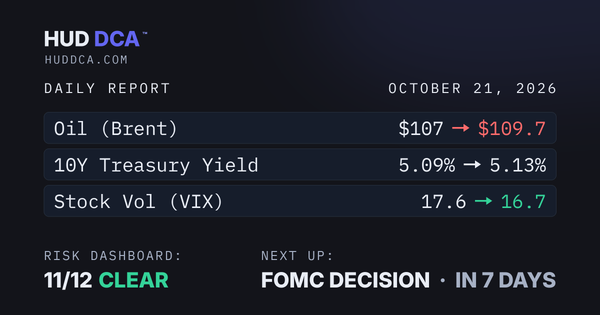
Treasury note: a loan to the U.S. government for a set term. The 2-year and 10-year are the two watched here; longer-dated issues are called bonds. Prices and yields move in opposite directions.
Spread: the extra interest a riskier borrower pays above the U.S. government.
On-chain: data taken from the Bitcoin blockchain rather than an exchange.
Altcoin: any cryptocurrency other than Bitcoin.
The signal
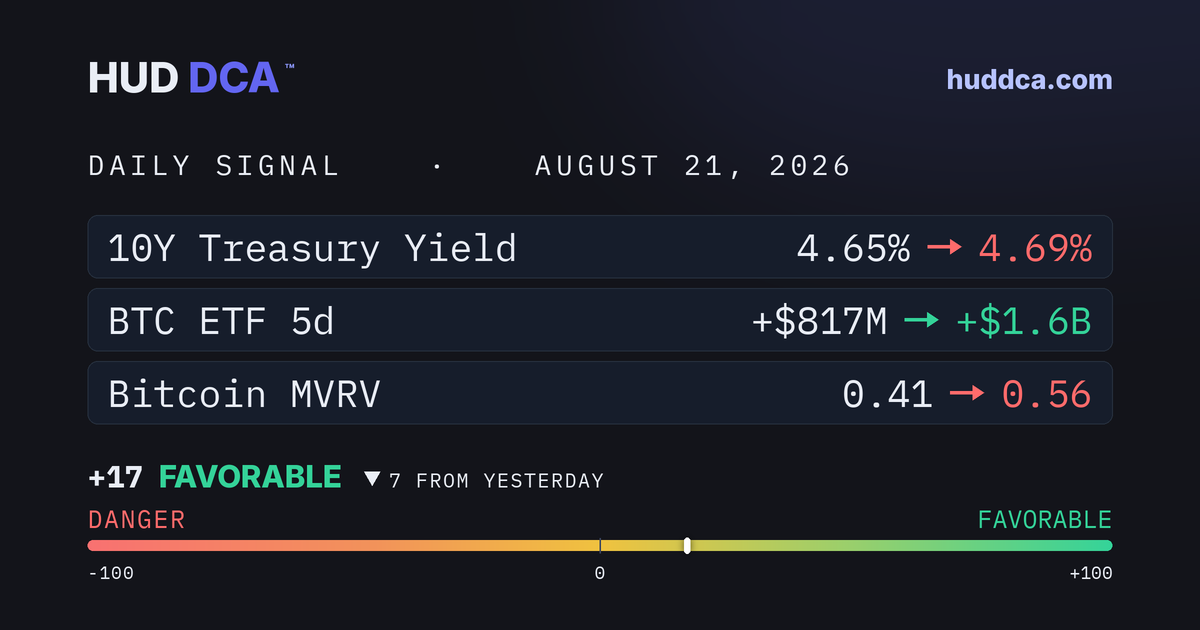
Composite score: every scored indicator becomes a positive or negative number, and those add into one figure. It reads conditions, not price.
Danger−30 and below
Cautious−29 to −10
Neutral−9 to +15
Favorable+16 to +55
Very favorable+56 and above
WAIT FOR: an automatic pause when a major release is a day or two out. Routine DCA continues; larger contributions wait for the number to print.
Quiet: part of the scoring set, but its trigger condition was not met today, so it adds nothing either way.
Contribution sizing: what each condition has historically looked like, not an instruction. Backtested results are hypothetical, not actual returns. Sizing is your decision.
Economy
Recession window (2Y vs 10Y): normally the 10-year note pays more than the 2-year. When it does not, the curve is inverted. The recession usually does not start while the curve is inverted — it tends to start after the curve returns to normal. The lag is long and variable, so treat this as a warning, not a countdown.
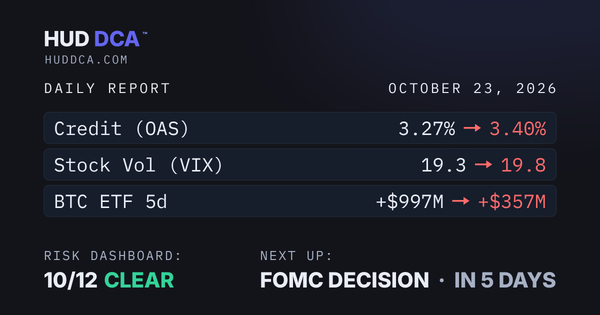
Corporate credit (OAS): the extra interest riskier companies pay to borrow. Low means lenders are relaxed; rising means they want more for the same risk. One catch: a very low spread is comfortable now but has often come before weaker years, because calm credit markets tend to get complacent right before they turn.
Jobs (Sahm rule): watches the speed of unemployment rather than the level.
ISM PMI: a monthly survey of the executives who place their companies’ orders. Above 50 means that sector is growing. The alert lines here sit just under 50 as an early warning; the whole economy does not contract until far lower.
US M2: the total pool of US dollars — not global M2.
U.S. dollar (DXY): the dollar against a basket of major currencies, though it is over half euro, so it is really a dollar-versus-Europe read. A strong dollar is a headwind for risk assets.
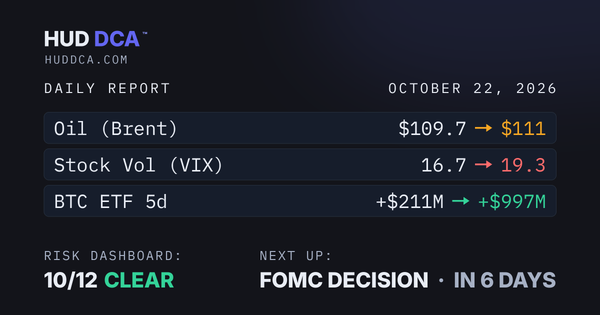
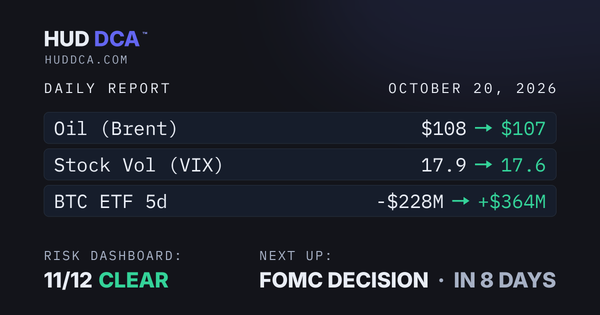
Oil (Brent): the global crude benchmark. Expensive oil is inflationary.
Stock volatility (VIX): the market’s fear gauge, priced from S&P 500 options over the coming month. Calm below 19.5; the engine pauses above 35.
Crypto
Crypto Fear & Greed: a 0 to 100 sentiment index, read as a contrarian gauge. Under 25 is high fear, over 75 is greed.
BTC ETF flows: net money into or out of the U.S. spot Bitcoin ETFs. They hold Bitcoin directly, so inflows genuinely buy coins.
200-day trend: Bitcoin against its 200-day moving average, the most watched long-term trend line. Below it is a downtrend.
Bitcoin dominance: Bitcoin’s share of total crypto market value. Rising means money is crowding into Bitcoin and away from altcoins.
MVRV Z-Score: what Bitcoin trades at today against what holders collectively paid on-chain. Low readings have historically marked accumulation.
NUPL: how much of the supply sits in profit. Shown for context but not scored, because it is mathematically close to MVRV.
Stablecoins: dollar-pegged crypto — cash parked inside the crypto system. Measured as a fixed basket of the seven largest, so the number moves only when their supply does, not when a tracker changes its list. It is a consistent gauge rather than the whole stablecoin market.
Cycle position: where the on-chain measures collectively sit. Conditions, not a forecast.
Risk dashboard
Alert line: the threshold each row is measured against. The bar shows how much room is left, and rows are ranked with the closest to trouble at the top. Crossing one does not mean sell — it means a watched condition changed.
Override triggers: six circuit breakers that can outrank the score. They do not all point the same way: extreme fear overrides upward, economic stress overrides downward.