Just the terms on this page. Fuller explanations live in the Briefing Room.
Start here
DCA: dollar-cost averaging: buying a fixed dollar amount on a regular schedule, whatever the price. It smooths out volatility rather than chasing the highest return on paper.
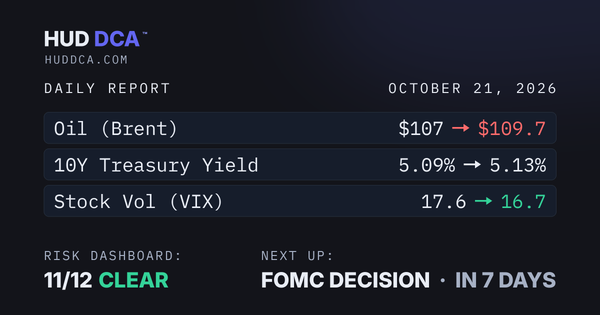
Treasury note: a loan to the U.S. government for a set term, and the 2-year and 10-year are the two watched here. Prices and yields move in opposite directions.
Spread: the extra interest a riskier borrower pays above the U.S. government.
On-chain: data taken from the Bitcoin blockchain rather than an exchange.
Altcoin: any cryptocurrency other than Bitcoin.
Ethereum (ETH): the second-largest digital asset, the coin of the Ethereum network.
Economy
Recession warning (2Y vs 10Y): normally the 10-year note pays more than the 2-year, and when it does not the curve is inverted. Recessions have tended to start after the curve returns to normal, with a long and variable lag, so this is a warning, not a countdown.
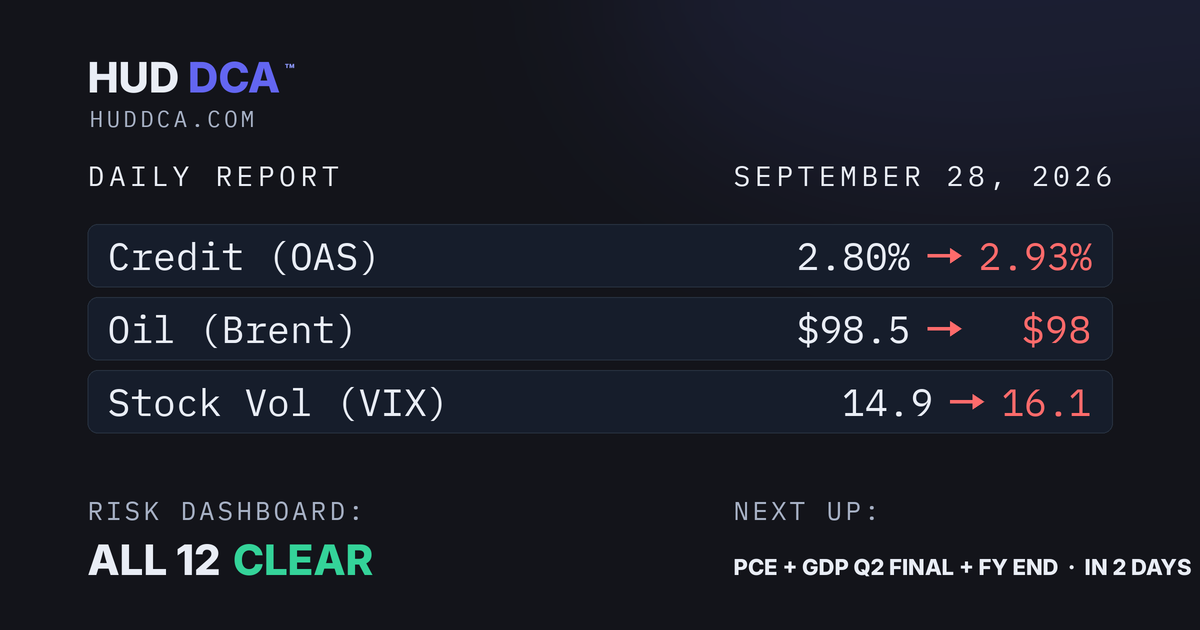
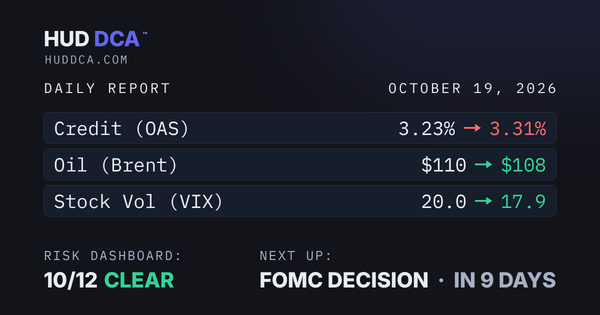
Corporate credit (OAS): the extra interest riskier companies pay to borrow above the U.S. government. Low means lenders are relaxed, though a very low spread has often come before weaker years.
Unemployment trend (Sahm rule): how fast unemployment is rising, not its level. Above 0.50 has signalled past U.S. recessions.
Factory and services activity (ISM): monthly surveys of the executives who place their companies’ orders, where above 50 means that sector is growing. The alert lines sit just under 50, at 48 for factories and 49 for services, as an early warning.
U.S. dollar (DXY): the dollar against a basket of major currencies, over half of it the euro. A strong dollar is a headwind for stocks and digital assets.
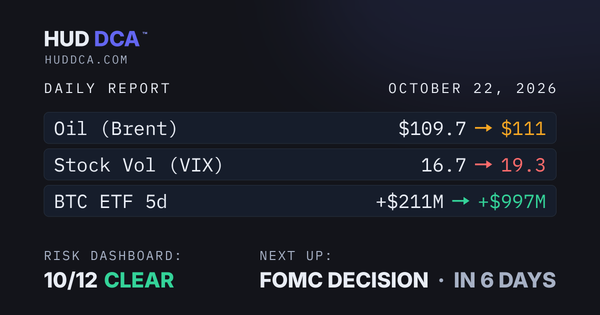
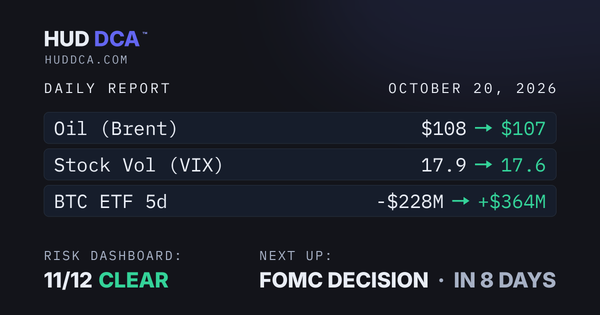
Oil (Brent): the global crude benchmark. Expensive oil squeezes consumers and pushes up inflation.
Stock-market fear (VIX)
: how much stock investors expect the S&P 500 to swing over the coming month, priced from options. Calm below 19.5, caution at 29.25 and alert at 35.
Crypto
Crypto Fear & Greed: a 0 to 100 sentiment index, read as a contrarian gauge. Under 25 is high fear, over 75 is greed.
Bitcoin fund flows (ETFs): net money into or out of the U.S. spot Bitcoin ETFs, funds you buy and sell like a stock. They hold real Bitcoin, so money flowing in means the funds are buying coins.
Bitcoin vs 200-day average: Bitcoin against its 200-day moving average, the most watched long-term trend line. Below it is a downtrend.
Bitcoin’s market share (dominance): Bitcoin’s share of total crypto market value. Rising means money is crowding into Bitcoin and away from altcoins.
MVRV Z-Score: what Bitcoin trades at today against what holders collectively paid. Low means the average holder is near break-even, high means large paper gains.
NUPL: how much of the supply sits in profit. Shown for context; it is mathematically close to MVRV.
Stablecoin cash: dollar-pegged digital cash parked inside the system, waiting to be invested. Measured as a fixed basket of the seven largest, so it moves only when their supply does.
Valuation level: read from MVRV Z-Score: Low under 1.0, Moderate 1.0 to 2.5, High 2.5 and above. It describes conditions, not a forecast.
Risk dashboard
Alert line: the level each reading is measured against, set where trouble has often followed. Crossing one means a watched condition changed, not that anything should be done.
Scheduled releases
ISM Manufacturing PMI: a monthly survey from the Institute for Supply Management. PMI stands for Purchasing Managers’ Index; the first read on factory demand.
ISM Services PMI: the same Institute for Supply Management survey, for service businesses; the read on the service economy.
Jobs report: the official monthly jobs count from the Bureau of Labor Statistics, often called payrolls or NFP (nonfarm payrolls); the month’s hiring and unemployment numbers.
CPI: the Consumer Price Index, the government’s main measure of inflation, from the Bureau of Labor Statistics; the main inflation number.
PPI: the Producer Price Index, from the Bureau of Labor Statistics; wholesale inflation.
PCE: the Personal Consumption Expenditures price index, from the Bureau of Economic Analysis; the inflation gauge the Federal Reserve targets.
GDP: Gross Domestic Product, from the Bureau of Economic Analysis; the economy’s growth rate.
FOMC: the Federal Open Market Committee, the group at the Federal Reserve that sets U.S. interest rates; the interest rate decision.
SEP and dot plot: the Summary of Economic Projections, published at four Fed meetings a year; the Fed’s own rate forecasts.
Fiscal year end: the end of the U.S. government’s budget year, on September 30; quarter-end fund rebalancing and the shutdown deadline.
Treasury refunding: the U.S. Treasury’s quarterly plan for how much the government will borrow; the government’s borrowing plan.
Midterm elections: the U.S. elections held halfway through a president’s term; control of Congress.
CLARITY Act
: the Digital Asset Market Clarity Act, a U.S. bill to set clear rules for crypto; the rules for digital assets.
Quarter-end rebalancing: large funds resetting their holdings at the end of each quarter; quarter-end fund flows.