June 22, 2026
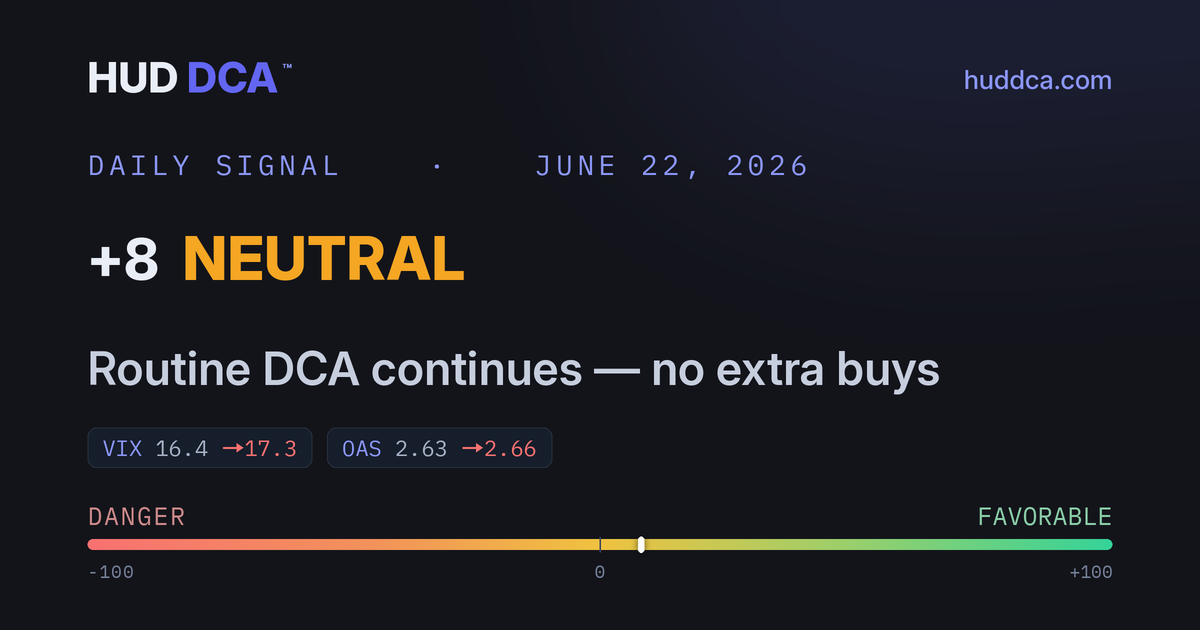
The patient-buyer setup is intact — extreme fear, Bitcoin below trend, a stable macro backdrop — but undervalued can stay undervalued. A neutral signal heading into Thursday's inflation read.
Today’s analysis
Read the full breakdown
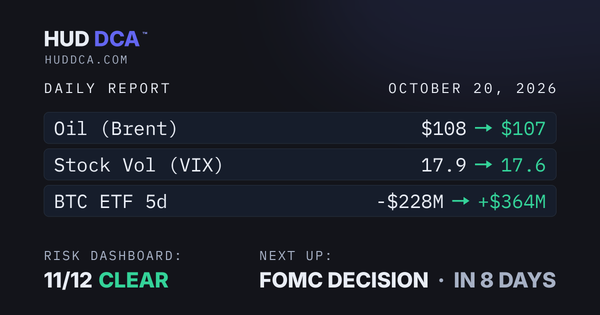
- The accumulation backdrop has not changed, and for a scheduled buyer that is the point. The Crypto Fear & Greed Index (a 0–100 gauge where low means panic) is pinned in extreme-fear territory, and historically the crowd is most fearful nearer to lows than highs. At the same time an on-chain measure called MVRV (Market Value to Realized Value, comparing price with what the average holder paid) still reads undervalued, and Bitcoin continues to trade below its 200-day average (the average price over the past 200 days, a line traders use to gauge the broader trend) — so price looks undervalued on more than one lens. Underneath, the macro frame stays supportive: corporate credit spreads (the extra yield risky companies pay to borrow, where low signals a calm economy) remain tight, the US money supply is still expanding, and oil sits low — the kind of quietly favorable conditions that reward patience over timing.
- Undervalued is not the same as turning. Bitcoin remains well below its 200-day average and has fallen sharply over the past month, so the broader downtrend is not clearly broken — and in stretches like this, “altcoins” (everything that is not Bitcoin) typically lag while Bitcoin leads any eventual recovery. The institutional read echoes the caution: the US spot Bitcoin ETFs (exchange-traded funds that let investors hold Bitcoin as easily as a stock) are still seeing net outflows, so the largest buyers have not stepped back in. None of this is alarming with credit calm and volatility low — but together it argues for holding to the schedule rather than chasing, since the value can persist, and may deepen, before momentum turns.
- June 25 is the one to circle. PCE (Personal Consumption Expenditures), the inflation gauge the Fed watches most closely, lands alongside the final estimate of first-quarter GDP (Gross Domestic Product, the broadest measure of economic output) — the first major inflation read since the Fed’s latest hawkish turn. A cooler-than-expected print would ease the pressure for the rate increase the Fed’s newest forecast now floats, while a hot one would harden it, and either can move stocks and crypto together. Beyond it, quarter-end fund rebalancing and Europe’s incoming crypto-rules deadline follow within the week — and through all of it, routine dollar-cost averaging carries on, which is the whole point of a schedule.